Assess and resuscitate a critically ill adult with the ABCDE approach
Run a cardiac arrest to current ALS guidance and treat peri-arrest arrhythmias
Recognise STEMI and its equivalents on the ECG, and start the right reperfusion pathway
Manage sepsis, shock, anaphylaxis and heat stroke in the first hour
Lead a trauma primary survey (xABCDE) and apply head-injury CT criteria
Follow evidence-based protocols for status epilepticus, DKA/HHS, hyperkalaemia and common poisonings
Interpret ABGs, document clearly and hand over safely
Each batch gets a private WhatsApp group where Zoom join links, recordings and case discussions are shared.
Sample certificate
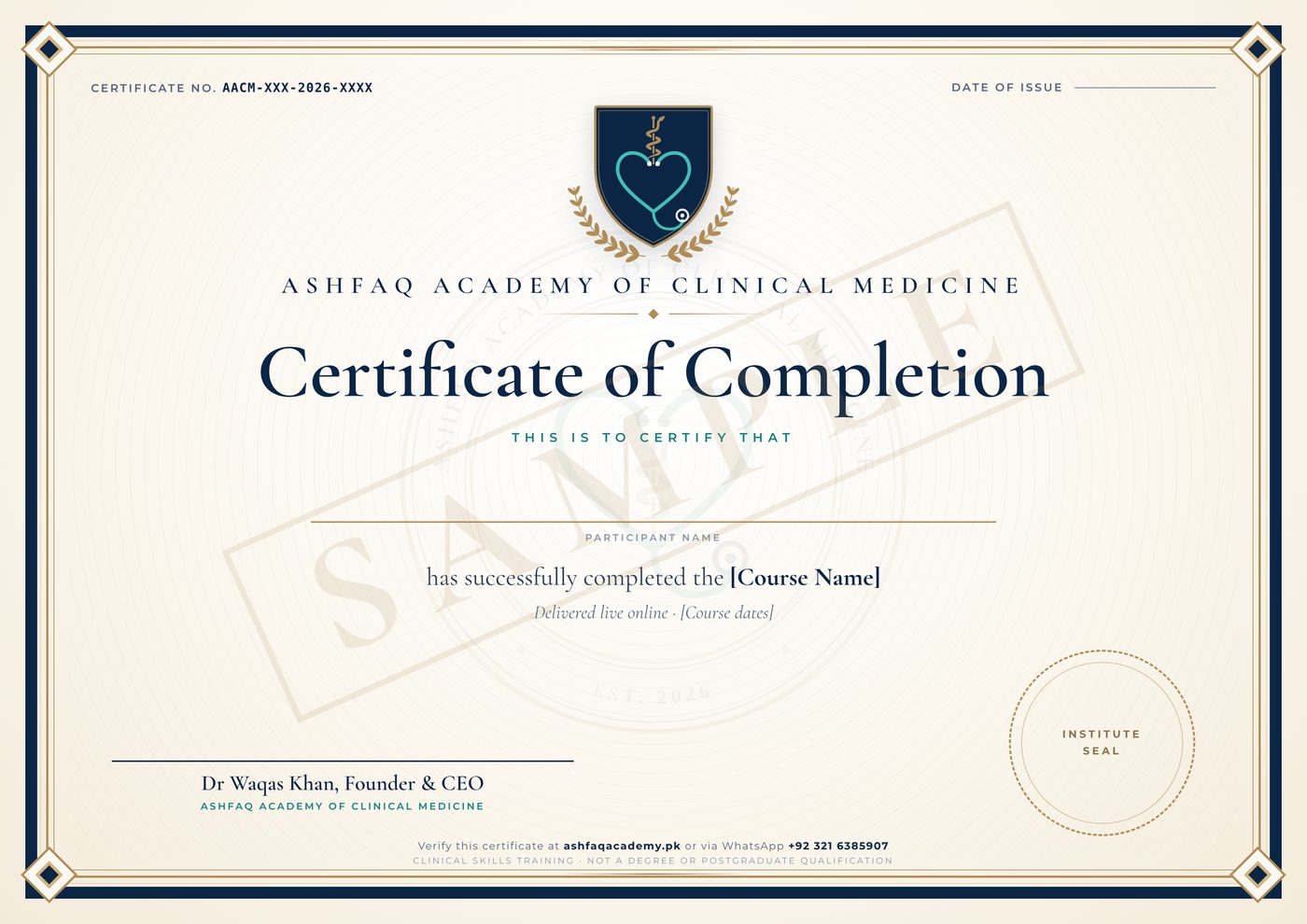
SAMPLESample certificate of completion (tap to enlarge). Yours carries your name, the course dates, a certificate number, Dr Waqas Khan's signature and the institute seal. PDF
Course details
About this course
Overview
A protocol-driven, case-based course for the adult emergencies that cannot wait. Over seven live online sessions you will practise a systematic ABCDE approach and step-by-step management of cardiac arrest and peri-arrest rhythms, chest pain and ACS, breathlessness, sepsis and shock, trauma, neurological and metabolic emergencies, and the poisonings common in Pakistan, with ECG and ABG interpretation, procedural skills and safe documentation and handover. Every day ends with two ready-to-use blueprints with real drug names and doses, based on current UK, European and international guidelines.
Who it's for
Medical officers and house officers in emergency departments and medical or surgical wards
Postgraduate trainees in emergency medicine, medicine, anaesthesia or surgery
Doctors preparing for MRCEM, PLAB or FCPS
GPs and doctors in district and private hospitals who see acutely unwell adults
Nurses and allied health professionals in emergency, ICU and ward settings
Eligibility: Doctors, nurses and allied health professionals.
Drug doses are taught for clinical understanding. Prescribing and procedures remain within each participant's role, local protocols and legal scope of practice.
Dates, timings & fees
Fee: PKR 3,000. Dates coming soon. Register your interest and we'll message you on WhatsApp first.
Timings: 8–10 PM PKT on Zoom · usually alternate days (8 PM PKT = 7 PM UAE · 6 PM KSA · 3 PM UK (GMT) / 4 PM UK (BST)).
Coming soon. Every enrolled student gets 6 months of access to the session recordings. Recorded-only access is also available, with the same 6 months of access: register and choose "Recorded", and we will share the details on WhatsApp.
The ABCDE approach in the resus bay — treat each problem as you find it, call for help early, reassess after every intervention
Spotting the deteriorating adult with NEWS2 (aggregate ≥7 = emergency response; any single red score = urgent review) and the warning signs that come hours before an arrest
High-quality CPR per RCUK/ERC 2025 — 100–120 compressions/min, 5–6 cm depth, 30:2, minimal pauses, swap compressors every 2 min
Shockable vs non-shockable rhythms, safe defibrillation, and the 4 Hs & 4 Ts reversible causes
ALS drugs — adrenaline 1 mg IV/IO; amiodarone 300 mg after the 3rd shock and 150 mg after the 5th (lidocaine 100 mg, then 50 mg, if amiodarone is unavailable)
Peri-arrest bradycardia — atropine, second-line adrenaline/isoprenaline infusions and transcutaneous pacing
Peri-arrest tachycardia — synchronised cardioversion for the unstable patient; vagal manoeuvres, adenosine and rate control for the stable one
Post-ROSC care — SpO₂ 94–98%, normocapnia, avoid hypotension (MAP ≥65 mmHg), 12-lead ECG for STEMI, prevent fever for at least 72 hours
Procedural skills — bag-valve-mask ventilation, airway adjuncts, supraglottic airways and IO access when IV fails
Red flags — do not miss
NEWS2 ≥7, or a single parameter scoring 3 — escalate now, not at the next ward round
New confusion, falling GCS or a respiratory rate ≥25 in a patient labelled “stable”
Bradycardia or tachycardia with shock, syncope, myocardial ischaemia or heart failure — adverse features demand treatment now
Broad-complex tachycardia in a patient with heart disease — treat as VT until proven otherwise
Signature blueprints
Adult Cardiac Arrest — the ALS Loop (RCUK/ERC 2025)
Unresponsive and not breathing normally → call the arrest team, start CPR 30:2, attach defibrillator pads with minimal interruption to compressions
Rhythm check every 2 min: VF/pulseless VT → one shock at your defibrillator's recommended biphasic energy → resume CPR immediately for 2 min
Non-shockable (PEA/asystole) → adrenaline 1 mg IV/IO as soon as possible, then every 3–5 min
Shockable → after the 3rd shock: adrenaline 1 mg + amiodarone 300 mg IV; after the 5th shock: amiodarone 150 mg; adrenaline every 3–5 min thereafter
Throughout: waveform capnography, airway by the most skilled operator, and a search for the 4 Hs (hypoxia, hypovolaemia, hypo/hyperkalaemia and metabolic, hypothermia) & 4 Ts (thrombosis, tension pneumothorax, tamponade, toxins)
ROSC → ABCDE, 12-lead ECG, SpO₂ 94–98%, avoid hypotension, and early cardiology referral if STEMI or a likely cardiac cause
Peri-arrest Rhythms — Brady & Tachy (RCUK 2025)
ABCDE, oxygen if SpO₂ <94%, IV access, 12-lead ECG — then look for life-threatening features: shock, syncope, myocardial ischaemia, severe heart failure
Bradycardia with adverse features → atropine 500 micrograms IV, repeat every 3–5 min to a total of 3 mg (not in heart-transplant patients or high-grade AV block with broad QRS)
Atropine ineffective → adrenaline 2–10 micrograms/min or isoprenaline 5 micrograms/min infusion, and transcutaneous pacing as a bridge to transvenous pacing
Unstable tachyarrhythmia → synchronised DC shock, up to 3 attempts, under sedation/anaesthesia; if unsuccessful, amiodarone 300 mg IV over 10–20 min, then repeat the shock
Stable regular narrow-complex → modified Valsalva → adenosine 6 mg rapid IV bolus, then 12 mg, then 18 mg (avoid if pre-excitation)
Stable broad-complex → treat as VT: synchronised shock, or (if sedation risk is high) procainamide 10–15 mg/kg over 20 min or amiodarone 300 mg IV over 10–60 min then 900 mg over 24 h, with expert advice
Pakistan context
Many emergency rooms share one defibrillator and have no waveform capnography or external pacing — how to run a high-quality arrest with what you have, and when to transfer.
Exam relevance
ALS algorithms, rhythm-strip recognition and the 4 Hs & 4 Ts are core material for MRCEM, PLAB 2 and FCPS emergency medicine and medicine vivas.
Consultant's pearl
“Most adult in-hospital arrests are predictable. The best resuscitation is the one you prevent by acting on the NEWS2 score an hour earlier.”
Day 2Chest Pain, ACS & the 12-lead ECGCardiovascular · ESC 2023 ACS · 2 hours
You'll master
A structured chest-pain approach built around the killers — ACS, aortic dissection, pulmonary embolism, tension pneumothorax, oesophageal rupture
A 12-lead ECG within 10 minutes for every chest pain, and a systematic reading routine — rate, rhythm, axis, intervals, ST segments and T waves
STEMI criteria (ESC 2023) and the equivalents you must not miss — posterior MI, LBBB or paced rhythm with ischaemic symptoms (Sgarbossa), de Winter T waves, Wellens' pattern, aVR elevation with widespread ST depression
The ESC 2023 NSTE-ACS pathway — high-sensitivity troponin 0/1-h (or 0/2-h) algorithms and risk stratification
Antiplatelet and anticoagulant loading — aspirin 150–300 mg orally, and a P2Y12 inhibitor timed to the reperfusion strategy
Fibrinolysis when primary PCI cannot be delivered within 120 minutes — indications, contraindications, streptokinase vs tenecteplase, and rescue PCI
Oxygen only if SpO₂ <90%; GTN and opioids for symptom relief, and when nitrates are dangerous (RV infarction, hypotension, recent PDE-5 inhibitor)
Aortic dissection red flags — and why you never thrombolyse tearing back pain
ECG skills beyond ischaemia — hyperkalaemia, pericarditis vs STEMI, WPW, Brugada and long QT
Red flags — do not miss
Chest pain with hypotension, a new murmur or pulmonary oedema — cardiogenic shock or a mechanical complication
Tearing pain radiating to the back, a pulse or BP difference between arms, or a new neurological deficit — think dissection before antithrombotics
Inferior STEMI with hypotension — record V4R; avoid nitrates in RV infarction
A normal first ECG does not exclude ACS — repeat it with ongoing or changing pain
Signature blueprints
STEMI — Door to Reperfusion (ESC 2023)
ECG within 10 min of first contact; STEMI = new J-point elevation in ≥2 contiguous leads: ≥1 mm in most leads; in V2–V3 ≥2 mm (men ≥40 y), ≥2.5 mm (men <40 y), ≥1.5 mm (women)
Aspirin 150–300 mg chewed (or 75–250 mg IV); titrated IV opioid only for severe pain; oxygen only if SpO₂ <90%
Primary PCI achievable within 120 min of diagnosis → activate transfer; P2Y12 (prasugrel 60 mg or ticagrelor 180 mg) and unfractionated heparin 70–100 units/kg IV at PCI
PCI not achievable within 120 min → fibrinolysis within 10 min of diagnosis: tenecteplase weight-based single bolus (half dose if ≥75 y) or streptokinase 1.5 million units IV over 30–60 min, with clopidogrel 300 mg (75 mg if >75 y)
Anticoagulation with lysis: enoxaparin 30 mg IV bolus, then 1 mg/kg SC 12-hourly if <75 y (no IV bolus and 0.75 mg/kg SC 12-hourly if ≥75 y), adjusted for renal function
Reassess at 60–90 min: <50% ST resolution or ongoing pain → rescue PCI; after successful lysis, angiography within 2–24 h
Undifferentiated Chest Pain & NSTE-ACS (ESC 2023)
ECG within 10 min, repeated whenever the pain recurs; high-sensitivity troponin at 0 h and 1 h (or 2 h) using the assay-specific algorithm
Rule-out, observe or rule-in — with a HEART score to support safe discharge decisions
Confirmed NSTEMI → aspirin 150–300 mg loading, anticoagulation (fondaparinux 2.5 mg SC daily, or enoxaparin 1 mg/kg SC 12-hourly adjusted for renal function), and cardiology review for an early (<24 h) invasive strategy
Before labelling chest pain “cardiac” or “musculoskeletal”, actively exclude dissection, PE, tension pneumothorax and oesophageal rupture
Pakistan context
Primary PCI is available in major cities but not in most district hospitals — streptokinase is still the most widely available lytic, so its dosing, hypotension and allergic reactions matter.
Exam relevance
ECG interpretation and STEMI/NSTEMI management are high-yield for MRCEM, PLAB 2 and FCPS emergency medicine and medicine.
Consultant's pearl
“Treat the ECG you have, not the troponin you are waiting for — and repeat the ECG every time the pain changes.”
COPD exacerbations — controlled oxygen to 88–92%, nebulised bronchodilators, prednisolone 30 mg daily for 5 days, antibiotics for purulent sputum, and NIV criteria (pH <7.35 and PaCO₂ >6.5 kPa despite optimal medical treatment)
Pulmonary embolism — two-level Wells score, D-dimer, CTPA, interim anticoagulation, and thrombolysis for high-risk PE
Acute pulmonary oedema — sit up, IV furosemide, nitrates if BP allows, CPAP; why routine morphine is no longer advised
Pneumothorax (BTS 2023) — primary vs secondary, conservative care, aspiration or ambulatory devices, chest drains, and tension pneumothorax
Oxygen prescribing (BTS) — target 94–98% for most patients, 88–92% for those at risk of hypercapnic respiratory failure
ABG interpretation in five steps — oxygenation, pH, primary process, compensation (Winter's formula: expected PaCO₂ = 1.5 × HCO₃⁻ + 8 ± 2 mmHg), anion gap and delta ratio
Procedural skills — needle decompression, finger thoracostomy and chest-drain insertion in the safe triangle
Red flags — do not miss
Silent chest, SpO₂ <92%, exhaustion, confusion or a normal/rising PaCO₂ in asthma — life-threatening; call ICU/anaesthesia
Breathlessness with hypotension, distended neck veins and absent breath sounds on one side — tension pneumothorax; decompress, don't wait for the X-ray
Suspected PE with syncope, hypotension or RV strain — high-risk PE
A drowsy COPD patient on high-flow oxygen — check an ABG for hypercapnia now
Signature blueprints
Acute Severe & Life-threatening Asthma (BTS/SIGN)
Oxygen to SpO₂ 94–98%; salbutamol 5 mg nebulised (oxygen-driven), repeated every 15–30 min or back-to-back if the response is poor
Add ipratropium bromide 0.5 mg nebulised 4–6-hourly for acute severe or poorly responding asthma
Steroids early: prednisolone 40–50 mg orally daily for at least 5 days, or hydrocortisone 100 mg IV 6-hourly if unable to take oral
Poor response → magnesium sulfate 1.2–2 g IV over 20 min as a single dose, after senior review
ABG if SpO₂ <92% or any life-threatening feature; a normal or raised PaCO₂ → urgent ICU/anaesthetic review
Before discharge: inhaler technique, steroid course, written asthma action plan and early follow-up
Suspected Pulmonary Embolism (NICE NG158 / ESC)
Two-level Wells score: PE likely (>4) → CTPA immediately, or interim anticoagulation if imaging is delayed; PE unlikely (≤4) → D-dimer, and CTPA if positive
Haemodynamically unstable (SBP <90 mmHg or vasopressors needed) → bedside echo for RV strain and systemic thrombolysis: alteplase 100 mg IV over 2 h (50 mg bolus in peri-arrest)
Stable PE → anticoagulate: apixaban 10 mg twice daily for 7 days, then 5 mg twice daily; or rivaroxaban 15 mg twice daily for 21 days, then 20 mg once daily
LMWH where DOACs are unsuitable (e.g. severe renal impairment, pregnancy, active cancer per specialist advice), dosed by weight and renal function
Low-risk PE (sPESI 0, no RV dysfunction) → consider outpatient care with early follow-up; treat for at least 3 months
Pakistan context
Many emergency rooms lack immediate CTPA — bedside echo, compression ultrasound and when to start empirical anticoagulation; plus the biomass-smoke COPD seen in rural women.
Exam relevance
ABG interpretation and asthma severity grading are favourite MRCEM, PLAB 2 and FCPS data-interpretation questions.
Consultant's pearl
“In acute asthma, a normal CO₂ in a breathless patient is not reassuring — it means they are tiring. Call for help before the gas goes up.”
Screening for sepsis with NEWS2 and clinical judgement — and why qSOFA alone is not recommended as a screening tool (SSC 2021)
The first hour in suspected septic shock — cultures, lactate, broad-spectrum antibiotics within 1 hour, balanced crystalloids
Shock at the bedside — hypovolaemic, distributive, cardiogenic and obstructive — using history, examination and point-of-care ultrasound
Vasopressors — noradrenaline first-line to a MAP of 65 mmHg, peripheral start when central access would delay it, and when to add vasopressin and hydrocortisone
Anaphylaxis (RCUK 2021) — recognition, IM adrenaline, refractory anaphylaxis and the low-dose adrenaline infusion
Heat stroke — core temperature >40 °C with CNS dysfunction; “cool first, transport second” with cold-water immersion or evaporative cooling to about 38.5–39 °C; no antipyretics; watch for rhabdomyolysis, AKI and DIC
Empirical antibiotics in a high-resistance setting — XDR typhoid, ESBL organisms and using your local antibiogram
Red flags — do not miss
Lactate ≥4 mmol/L, or hypotension after fluid resuscitation — septic shock; involve critical care early
Mottled skin, capillary refill >3 s, falling urine output or new confusion
Stridor, hoarse voice, wheeze or hypotension after a sting, drug or food — give IM adrenaline now
Confusion with a high temperature in a labourer, athlete or older person during a heatwave — heat stroke until proven otherwise
Signature blueprints
Septic Shock — the First Hour (Surviving Sepsis Campaign 2021, adult)
Recognise: suspected infection with organ dysfunction; measure lactate
Blood cultures (without delaying treatment) → broad-spectrum IV antibiotics within 1 hour for probable sepsis or shock; within 3 hours if sepsis is possible without shock and concern persists
Hypoperfusion or shock → balanced crystalloid (e.g. Ringer's lactate), SSC suggests 30 mL/kg within the first 3 hours, given as boluses with reassessment after each (extra caution in heart or renal failure)
MAP <65 mmHg despite fluids → noradrenaline (a peripheral start is acceptable), titrated to MAP 65 mmHg
Noradrenaline 0.25–0.5 micrograms/kg/min → add vasopressin; ongoing vasopressor need (noradrenaline ≥0.25 micrograms/kg/min for ≥4 h) → hydrocortisone 200 mg/day (e.g. 50 mg IV 6-hourly)
Source control as early as practical; repeat lactate to guide resuscitation; early ICU referral
Anaphylaxis (Resuscitation Council UK 2021)
Airway, breathing or circulation problem after a likely trigger → call for help, remove the trigger, lie flat (sit up if breathing is difficult; never stand the patient up)
Adrenaline 0.5 mg IM (0.5 mL of 1 mg/mL, i.e. 1:1000) into the anterolateral thigh; repeat after 5 min if there is no improvement
High-flow oxygen; for shock, IV crystalloid bolus 500–1000 mL
No improvement after 2 IM doses → refractory anaphylaxis: low-dose adrenaline infusion with critical-care help, continuing IM adrenaline every 5 min until it runs
Antihistamines are not first-line and corticosteroids are no longer routine in the emergency phase; consider them only after initial resuscitation
Observe according to the response, take mast-cell tryptase samples, and discharge with allergy referral, a written plan and an adrenaline auto-injector where available
Pakistan context
Heatwaves in Sindh and southern Punjab (Jacobabad, the 2015 Karachi heatwave), XDR typhoid and ESBL organisms — choosing empirical antibiotics in a high-resistance setting.
Exam relevance
Sepsis bundles, shock classification and anaphylaxis adrenaline doses are tested constantly in MRCEM, PLAB 2 and FCPS.
Consultant's pearl
“In anaphylaxis, the only drug that saves lives in the first minutes is IM adrenaline — if you are wondering whether to give it, give it.”
Day 5Trauma: xABCDE, Haemorrhage Control & Head InjuryTrauma · ATLS 11th edition, NICE NG232 · 2 hours
You'll master
The ATLS 11th edition xABCDE primary survey — control exsanguinating external haemorrhage first with direct pressure, wound packing, tourniquets and a pelvic binder
Airway with cervical-spine protection; breathing — the immediately life-threatening chest injuries (tension pneumothorax, open pneumothorax, massive haemothorax, flail chest, cardiac tamponade)
Circulation — recognising haemorrhagic shock, eFAST, damage-control resuscitation, limited crystalloid, early blood products (1:1:1) and permissive hypotension (not in head injury)
Tranexamic acid (CRASH-2) — 1 g IV over 10 min within 3 hours of injury, then 1 g over 8 hours
Head injury — GCS, pupils, NICE NG232 CT criteria and preventing secondary brain injury
Secondary survey, AMPLE history, log roll, imaging decisions and safe transfer to definitive care
Procedural skills — tourniquet and pelvic binder application, needle and finger thoracostomy, chest drain and the eFAST views
Red flags — do not miss
SBP <90 mmHg, HR >120, or a falling GCS after trauma
A unilateral fixed dilated pupil, or bradycardia with hypertension (Cushing's response) — raised intracranial pressure
Penetrating torso injury with shock — this patient needs a surgeon, not a CT scan
A head-injured patient on anticoagulants, even with GCS 15
Signature blueprints
xABCDE Primary Survey & Haemorrhage Control (ATLS 11th)
x — exsanguinating external bleeding: direct pressure, wound packing, a tourniquet applied high and tight; pelvic binder centred over the greater trochanters for suspected pelvic fracture
A — airway with cervical-spine restriction; definitive airway if GCS ≤8 or the airway is threatened
B — look, feel, listen; decompress tension pneumothorax (4th/5th intercostal space just anterior to the mid-axillary line), seal an open chest wound, chest drain for massive haemothorax
C — two large-bore cannulas or IO, bloods with group and crossmatch, eFAST; limit crystalloid, give blood early (1:1:1), tranexamic acid 1 g IV within 3 h; permissive hypotension (SBP about 80–90 mmHg) until bleeding is controlled, except in head injury
D — GCS, pupils and glucose; E — expose fully, then prevent hypothermia with warmed fluids and blankets
Reassess after every intervention and decide early on surgery, interventional radiology or transfer
Assess GCS (E4 V5 M6), pupils and anticoagulant use; protect the cervical spine when indicated
CT head within 1 hour if: GCS ≤12 on initial ED assessment; GCS <15 two hours after injury; suspected open or depressed skull fracture; signs of basal skull fracture; post-traumatic seizure; focal neurological deficit; more than one episode of vomiting
Loss of consciousness or amnesia plus age ≥65, a bleeding/clotting disorder, a dangerous mechanism or >30 min retrograde amnesia → CT within 8 hours; on anticoagulants or antiplatelets (other than aspirin alone) with no other indication → consider CT within 8 hours
Prevent secondary injury: avoid hypoxia and hypotension, aim for normocapnia, treat hypo/hyperglycaemia, head-up 30°, analgesia and seizure control
Signs of herniation → urgent neurosurgical discussion; hyperosmolar therapy (mannitol or hypertonic saline per local protocol) as a bridge to definitive care
Discharge only when criteria are met, with written head-injury advice and a responsible adult at home
Pakistan context
Road-traffic and motorcycle head injuries, firearm and fall-from-height trauma, and long transfers to neurosurgery — packaging the patient safely for the journey.
Exam relevance
The xABCDE primary survey and NICE head-CT criteria are classic MRCEM, PLAB 2 and FCPS emergency and surgery scenarios.
Consultant's pearl
“Hypoxia and hypotension double the harm of a head injury — fix the airway, breathing and circulation before you worry about the scan.”
Stroke — FAST/ROSIER recognition, glucose check, immediate non-contrast CT; thrombolysis within 4.5 hours (alteplase 0.9 mg/kg, max 90 mg — 10% as a bolus, the rest over 60 min — or tenecteplase 0.25 mg/kg, max 25 mg, single bolus); BP <185/110 mmHg before lysis; thrombectomy referral
Aspirin 300 mg daily for 2 weeks once haemorrhage is excluded (24 hours after thrombolysis, if given)
Status epilepticus — the NICE NG217 timeline from first benzodiazepine to anaesthesia
Reduced GCS — airway first; glucose (treat if <4 mmol/L, with IV thiamine if alcohol or malnutrition is suspected), naloxone for an opioid toxidrome, then CT and the meningitis/encephalitis decision
HHS (JBDS) — osmolality ≥320 mOsm/kg, glucose ≥30 mmol/L, no significant ketonaemia; fluid-first, slow correction (osmolality fall 3–8 mOsm/kg/h), insulin 0.05 units/kg/h only once glucose stops falling with fluids (unless ketones >1 mmol/L), VTE prophylaxis
Hyperkalaemia (UKKA 2023) — 30 mL 10% calcium gluconate IV over 10 min for ECG changes (10 mL 10% calcium chloride in peri-arrest); insulin 10 units with 25 g glucose IV; 10% glucose 50 mL/h for 5 h if pre-treatment glucose <7 mmol/L; nebulised salbutamol 10–20 mg
Hypokalaemia — oral vs IV replacement, a maximum peripheral IV rate of 10 mmol/h outside critical care, and always check magnesium
Hyponatraemia (European guideline) — severe symptoms: 150 mL 3% saline over 20 min, repeated (usually up to twice) until sodium rises by 5 mmol/L; limit correction to 10 mmol/L in the first 24 h and 8 mmol/L in each 24 h thereafter
Sudden focal deficit — the time last seen well decides everything; check glucose first
Seizure lasting ≥5 min, or repeated seizures without recovery — status epilepticus
Kussmaul breathing, vomiting and abdominal pain in a person with diabetes (or a young adult) — check ketones for DKA
K⁺ ≥6.5 mmol/L, or any hyperkalaemic ECG change — treat immediately
Signature blueprints
Convulsive Status Epilepticus (NICE NG217)
0–5 min: airway, oxygen, glucose check (treat if <4 mmol/L), IV access, time the seizure
At 5 min: lorazepam 0.1 mg/kg IV (max 4 mg); no IV access → buccal midazolam 10 mg or rectal diazepam 10–20 mg
Still seizing 5–10 min later → repeat the benzodiazepine once
Still seizing → second-line IV: levetiracetam 60 mg/kg (max 4,500 mg) over 10 min, or phenytoin 20 mg/kg at no more than 50 mg/min with ECG monitoring, or sodium valproate 40 mg/kg (max 3,000 mg) over 10 min (avoid valproate in women who could be pregnant)
Refractory (still seizing ~30 min) → anaesthetist for rapid sequence induction and ICU
Look for the cause throughout: hypoglycaemia, hyponatraemia, eclampsia (magnesium sulfate), alcohol withdrawal, CNS infection and toxins; IV thiamine if alcohol or malnutrition
Fluids, 0.9% saline: SBP <90 mmHg → 500 mL over 10–15 min and senior review; otherwise 1 L over 1 h, then 1 L over 2 h, 1 L over 2 h, 1 L over 4 h (more cautious in older adults, ages 18–25, pregnancy, heart or renal failure)
Fixed-rate IV insulin 0.1 units/kg/h (50 units soluble insulin in 50 mL 0.9% saline); continue the usual long-acting basal insulin
Potassium per litre of fluid: >5.5 mmol/L none; 3.5–5.5 mmol/L add 40 mmol/L; <3.5 mmol/L senior review for additional potassium
Glucose <14 mmol/L → add 10% glucose at 125 mL/h alongside the saline, and consider reducing insulin to 0.05 units/kg/h
Targets: ketones fall ≥0.5 mmol/L/h, bicarbonate rises ≥3 mmol/L/h; continue until ketones <0.6 mmol/L and pH >7.3 and/or bicarbonate >18 mmol/L; LMWH thromboprophylaxis
Pakistan context
Late-presenting DKA without home ketone meters, insulin affordability, Ramadan-fasting metabolic emergencies, and few stroke units — recognising lysis-eligible patients early matters.
Exam relevance
Status epilepticus timelines, DKA protocols and hyperkalaemia ECGs are high-yield for MRCEM, PLAB 2 and FCPS medicine.
Consultant's pearl
“In DKA, potassium kills more often than glucose — check it before the insulin and every two hours after.”
Day 7Toxicology, GI Emergencies & Safe ED PracticeToxicology, GI & ED systems · NICE, WHO · 2 hours
You'll master
Toxidromes at the bedside — cholinergic, anticholinergic, sympathomimetic, opioid and sedative-hypnotic — and when activated charcoal (50 g within 1 hour, airway protected) helps
Organophosphate pesticide poisoning — early, aggressive atropinisation and monitoring for the intermediate syndrome
Paracetamol — the UK treatment line (100 mg/L at 4 h), staggered or unknown-time ingestions, and acetylcysteine (21-hour regimen: 150 mg/kg over 1 h, 50 mg/kg over 4 h, 100 mg/kg over 16 h; weight capped at 110 kg — or the shorter regimen where locally adopted)
Snakebite in Pakistan — saw-scaled viper, Russell's viper, cobra and krait; the 20-minute whole-blood clotting test; polyvalent anti-snake venom (ASV) indications and dosing per national protocol; treating ASV reactions with IM adrenaline; neostigmine with atropine cover for neurotoxic bites; no tourniquets or incisions
Aluminium phosphide (“wheat pill”) — no antidote; early ICU, aggressive shock management, correction of acidosis, ECG monitoring for arrhythmias, and protecting staff from phosphine gas; vs superwarfarin rat poisons, which need vitamin K and INR monitoring
Benzodiazepine and opioid overdose — airway first; naloxone 400 micrograms IV/IM titrated to breathing (smaller increments in opioid dependence), an infusion for long-acting opioids; why flumazenil is avoided in mixed or chronic users
Upper GI bleeding — Glasgow-Blatchford score, restrictive transfusion, endoscopy timing, variceal bleeding, and why tranexamic acid is not used (HALT-IT)
The acute abdomen — AAA, ectopic pregnancy (pregnancy test in every woman of reproductive age), perforation, obstruction, mesenteric ischaemia, pancreatitis, cholangitis, appendicitis; early analgesia does not mask the diagnosis
ED documentation & handover — SBAR/ISBAR, NEWS2 trends, safety-netting, capacity and consent, leaving against medical advice (LAMA), and medico-legal (MLC) cases and police reporting in Pakistan
Red flags — do not miss
Pinpoint pupils, bronchorrhoea, bradycardia and fasciculations — organophosphate poisoning; atropinise early
Bleeding gums, haematuria or non-clotting blood after a snakebite — systemic envenoming; give ASV now
Haematemesis with tachycardia, hypotension or syncope, or known liver disease — high-risk GI bleed
Abdominal pain with hypotension in an older adult (AAA) or a woman of reproductive age (ectopic) — call the surgeon or gynaecologist immediately
Protect staff (gloves, remove contaminated clothes); airway, high-flow oxygen, suction secretions; record pupils, HR, BP, chest sounds and sweating
Atropine 1.8–3 mg IV rapid bolus; reassess after 5 min — if not atropinised, double the dose (3.6 mg, 7.2 mg …) every 5 min
Atropinised = clear chest on auscultation, HR >80/min, SBP >80 mmHg, dry axillae, pupils no longer pinpoint
Maintain with an infusion of 10–20% of the total loading dose per hour; watch for atropine toxicity (confusion, hyperthermia, absent bowel sounds, urinary retention) — stop, then restart at a lower rate once it settles
Pralidoxime per local protocol (benefit uncertain); diazepam for seizures or severe agitation; avoid suxamethonium for intubation (prolonged paralysis)
Observe for the intermediate syndrome (neck-flexion weakness, cranial nerve palsies, respiratory failure) typically 24–96 hours after ingestion
Upper GI Bleed (NICE CG141 / ESGE)
ABCDE, two large-bore cannulas; FBC, urea and electrolytes, LFTs, clotting, group and crossmatch
Glasgow-Blatchford score: 0 (≤1 per ESGE) → consider early outpatient management; higher scores → admit for endoscopy
Restrictive transfusion: Hb threshold 70 g/L (target 70–90 g/L), 80 g/L with cardiovascular disease; platelets if <50 × 10⁹/L with active bleeding; correct coagulopathy and reverse anticoagulants
Suspected variceal bleed → terlipressin 2 mg IV 4-hourly (reduce to 1 mg 4-hourly once controlled) + prophylactic antibiotics (e.g. ceftriaxone 1 g IV daily) before endoscopy
Endoscopy immediately after resuscitation if unstable, otherwise within 24 h; PPI after endoscopy for non-variceal bleeding (not before, per NICE); no tranexamic acid
Re-bleeding → repeat endoscopy, interventional radiology or surgery
Pakistan context
Organophosphate and aluminium-phosphide self-poisoning, snakebite in rural Sindh and Punjab, hepatitis-related cirrhosis driving variceal bleeds, and MLC documentation duties in public hospitals.
Exam relevance
Toxidromes, paracetamol nomogram questions and Glasgow-Blatchford scoring appear regularly in MRCEM, PLAB 2 and FCPS emergency medicine and medicine.
Consultant's pearl
“Under-atropinisation kills more organophosphate patients than atropine toxicity — double the dose every five minutes until the chest is clear, then hold the line with an infusion.”
Why this curriculum is differentBlueprints, Pakistani practice, current guidance, exam + bedside
Exact blueprints, not theory: Every day ends in two ready-to-use algorithms — real drug names and real doses.
Built for Pakistani emergency rooms: Organophosphates, aluminium phosphide, snakebite, heat stroke and XDR typhoid — the emergencies you actually see, in resource-limited settings.
UK emergency-department standards, adapted to Pakistan: Taught by a GMC-registered doctor with experience in emergency medicine across multiple NHS hospitals in the UK.
Exam + bedside, together: Every topic is mapped to how MRCEM, PLAB 2 and FCPS examiners test it.
Everything includedLive sessions, recordings, dose cheat-sheet, case group, certificate
7 live 2-hour sessions
All session recordings, with 6 months of access
Adult emergency drug-dose cheat-sheet
Free WhatsApp case-discussion group for all members
Certificate of completion, issued within 7 days of the final class
Faculty
Who teaches this course
Meet the faculty
Photo coming soon
Faculty
Dr Iqra
GMC-registered doctor
Emergency medicine experience across multiple NHS hospitals in the UK
A GMC-registered doctor with experience in emergency medicine across multiple NHS hospitals in the UK, teaching the academy's Adult Emergency Medicine Masterclass.
Try before you register
Sample lecture & notes
Sample lecture
Sample lecture Video coming soon
Sample notes
A preview of the notes you'll receive with this course.
Sample notes coming soon
FAQs
Common questions
When will this course start?
Dates are coming soon. Register your interest or contact us on WhatsApp, and we will message you as soon as the dates are confirmed.
Who can join?
Doctors, nurses and allied health professionals who manage acutely unwell adults, from house officers to consultants, and emergency, ICU and ward nurses.
How is the course run?
Seven live classes on Zoom, 8–10 PM Pakistan time, usually on alternate days (not consecutive). Batches are kept small for individual attention, and every session is recorded.
What is the fee?
The fee is a fixed PKR 3,000 for the 7-session course. There is no early-bird offer.
Is this a certified life-support course (e.g. ALS, ACLS or ATLS)?
No. It is a clinical skills training course that follows current resuscitation and trauma guidance, but it is not an official ALS, ACLS or ATLS certification.
SAMPLESample certificate of completion (tap to enlarge). Yours carries your name, the course dates, a certificate number, Dr Waqas Khan's signature and the institute seal. PDF
Who teaches this course?
A GMC-registered doctor with experience in emergency medicine across multiple NHS hospitals in the UK. See the faculty section on this page.
Will I get a certificate?
Yes, a certificate of completion, issued within 7 days of the final class. This is clinical skills training, not a PMDC/HEC-recognised degree or postgraduate qualification.
SAMPLESample certificate of completion (tap to enlarge). Yours carries your name, the course dates, a certificate number, Dr Waqas Khan's signature and the institute seal. PDF
Will I get the recordings?
Yes. Every enrolled student gets 6 months of access to the session recordings, so a missed class is never a missed topic.
Is there a case-discussion group?
Yes. All members can join our free WhatsApp case-discussion group.
Do returning students get a discount?
Yes. If you have attended any of our courses or workshops before, you get a discount on your next one. Please ask us on WhatsApp for the current discount.
How do I get the Zoom link and recordings?
Each batch has its own private WhatsApp group. Zoom join links, recordings and case discussions are shared there. You are added once your payment is confirmed.
I live outside Pakistan. Can I join?
Yes, overseas students are welcome. 8 PM Pakistan time is 7 PM in the UAE, 6 PM in Saudi Arabia and 3 PM in the UK in winter (GMT), or 4 PM during British Summer Time. Register with your own country code and pay by JazzCash, Easypaisa or UBL bank transfer.
How do I register and pay?
Fill in the registration form and choose your course. You will get a reference number such as AACM-261019-AB12.
Send the course fee to one of our accounts: JazzCash: 03216385907 (Waqas Khan); Easypaisa: 03216385907 (Waqas Khan); UBL (United Bank Limited): account title Waqas Khan, account no. 0381318599799, IBAN PK33UNIL0109000318599799. Please write your reference number in the transfer note.
Upload your payment receipt (image or PDF, up to 8 MB) with the transaction ID.
We verify your payment and confirm your seat on WhatsApp. You can download a PDF of your registration straight away.
Courses marked 'Coming soon' only need a short 'register interest' form; there is no payment until dates are announced.