
Ashfaq Academyof Clinical Medicine

Dermatology & Aesthetics

Comprehensive Aesthetic Medicine Hands-on Course

Three months of supervised, hands-on aesthetic training, built on safety first.

  • Next batchDates announced soon
  • FeeContact us
  • FormatIn person · Bahria Town, Lahore
  • TimeTimings by enquiry with the clinic or on WhatsApp

Who can join? Doctors, nurses & allied health professionals

Why this course

What you get

  • Assess and select aesthetic patients safely, with clear consent and photography
  • Apply facial anatomy and danger-zone knowledge to every procedure
  • Recognise and manage complications, including vascular occlusion and anaphylaxis
  • Perform core non-invasive treatments: peels, facials, LED, lasers and IPL, under supervision
  • Understand and practise botulinum toxin, fillers, PRP, skin boosters and threads within your scope of practice
  • Run an ethical, compliant aesthetic practice in Punjab

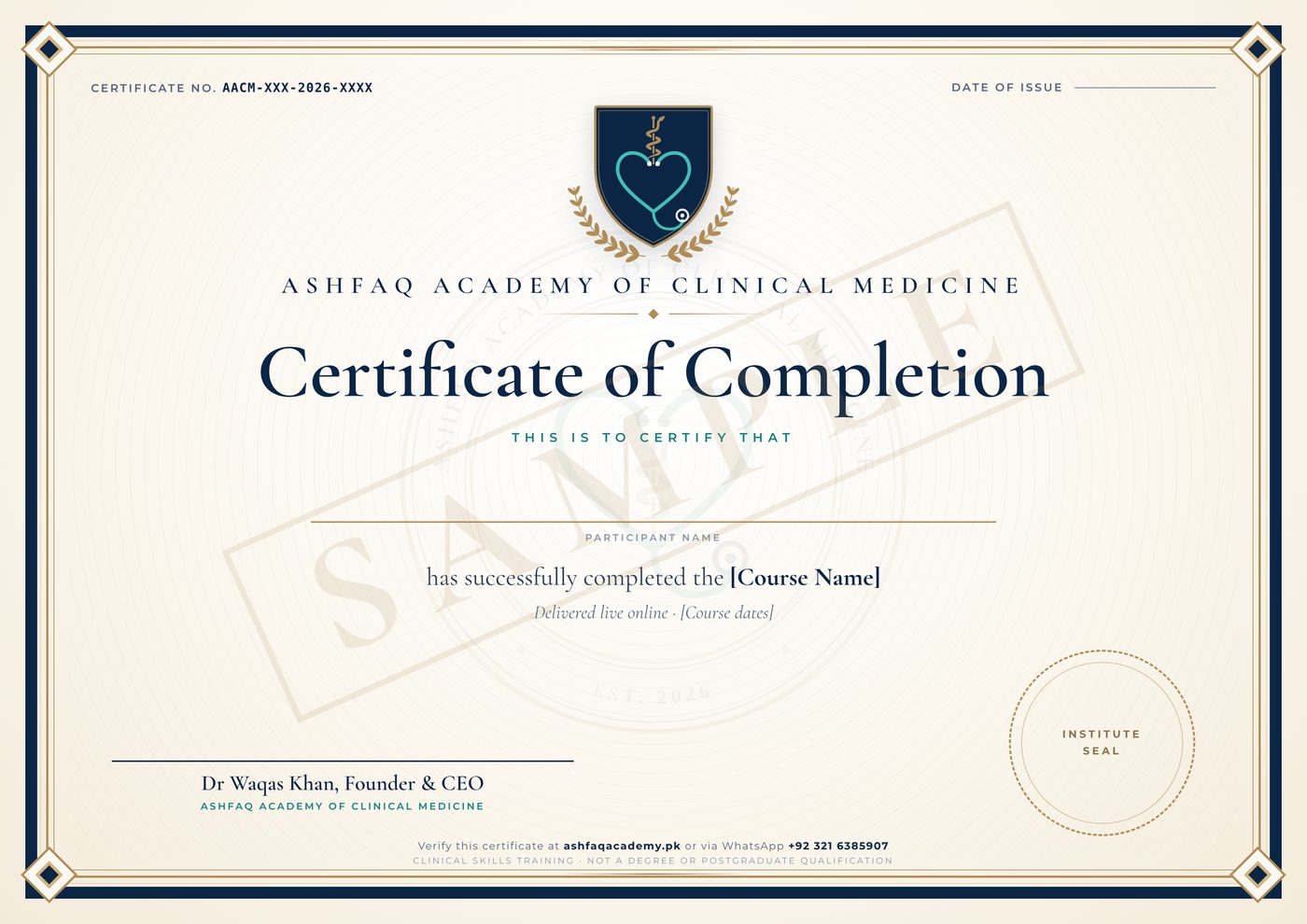
Sample certificate

Sample certificate of completion from Ashfaq Academy of Clinical Medicine, marked SAMPLE SAMPLE
Sample certificate of completion (tap to enlarge). Yours carries your name, the course dates, a certificate number, Dr Waqas Khan's signature and the institute seal. PDF
Course details

About this course

Overview

A comprehensive, in-person aesthetic medicine course held in Bahria Town, Lahore, and led by Mehak Ishtiaq, Head of Dermatology & Aesthetics. Over 12 weeks you move from the foundations (skin and facial anatomy, danger zones, consultation, consent, photography, infection control and emergency management) through non-invasive treatments such as peels, lasers and energy-based devices, to minimally invasive procedures including botulinum toxin, dermal fillers, PRP, skin boosters and threads. Every week combines theory and demonstration with supervised hands-on practice on models, and the course closes with business, ethics, regulation and a final assessment.

Who it's for
  • Doctors, nurses and allied health professionals who want structured, supervised aesthetic training
  • Clinicians starting or formalising aesthetic services
  • Practitioners who want a safety-first grounding in complications and emergency care

Eligibility: Doctors, nurses and allied health professionals.

Injectable and invasive procedures are performed only within each participant's legal scope of practice.

'Certified' means an AACM certificate of completion. This is clinical skills training, not a PMDC/HEC-recognised degree or postgraduate qualification.

Dates, timings & fees

Timings: Timings by enquiry with the clinic or on WhatsApp.

Contact us for the next start date.

How you can take it
Curriculum

What we cover

Open a day or module below. Everything is still here — just collapsed so the page stays easy to scan.

  • Physical, in-person training in Bahria Town, Lahore, over 3 months (12 weeks)
  • Every week combines theory and live demonstration with supervised hands-on practice on models
  • Safety first: anatomy, danger zones, complications and emergency protocols are taught before any injectable work
  • Final practical and written assessment, and an AACM certificate of completion

Week by week

  1. Week 1Skin science & facial anatomyFoundations · skin, ageing, facial layers, danger zones
  2. Week 2Consultation, consent, photography & infection controlFoundations · patient assessment and safe clinic practice
  3. Week 3Complications & emergency managementFoundations · vascular occlusion, anaphylaxis, emergency kit
  4. Week 4Skin care, cosmeceuticals & chemical peelsNon-invasive · skin preparation and peels by depth
  5. Week 5Facial treatments, LED & acne managementNon-invasive · microdermabrasion, HydraFacial, LED
  6. Week 6Lasers & IPLNon-invasive · laser safety, hair removal, pigment, resurfacing
  7. Week 7Energy-based devices, microneedling & PRPNon-invasive & minimally invasive · RF, HIFU, microneedling, PRP
  8. Week 8Botulinum toxin I: upper faceMinimally invasive · toxin pharmacology and upper-face treatment
  9. Week 9Botulinum toxin II & dermal fillers IMinimally invasive · advanced toxin, filler fundamentals
  10. Week 10Dermal fillers II, skin boosters & fat-dissolving injectionsMinimally invasive · advanced filler areas, boosters, mesotherapy
  11. Week 11Threads, sclerotherapy & scar managementMinimally invasive · PDO threads, sclerotherapy basics, scar revision
  12. Week 12Business, ethics, regulation & final assessmentPractice · PHC Punjab, ethics, assessment, certification

Full curriculum

Tap a week to see the theory and the supervised hands-on practice.

Week 1Skin science & facial anatomyFoundations · skin, ageing, facial layers, danger zones

Theory & demonstration

Skin structure & ageing
  • Skin structure and function, wound healing and collagen biology
  • Fitzpatrick skin types and what they mean for South Asian skin
  • Intrinsic vs extrinsic ageing; Glogau photoageing classification
Facial anatomy for injectors
  • Facial layers, fat compartments and ligaments; how the face ages layer by layer
  • Muscles of facial expression and their actions
  • Arterial and venous anatomy of the face; nerve pathways
  • Danger zones: glabella, nose, nasolabial fold, temple, periorbital region and lips
  • Sensory nerves of the face (supraorbital, supratrochlear, infraorbital, mental) and their foramina, as the basis for regional nerve blocks
  • Anatomy of the neck, décolletage, hands and scalp for non-facial treatments

Supervised hands-on

  • Surface anatomy mapping and marking of danger zones on models
  • Facial analysis: proportions, symmetry and volume assessment
Week 2Consultation, consent, photography & infection controlFoundations · patient assessment and safe clinic practice

Theory & demonstration

Patient assessment
  • The aesthetic consultation: concerns, medical history, medications and previous treatments
  • Patient selection, contraindications and when to say no
  • Recognising body dysmorphic disorder and unrealistic expectations
Consent & records
  • Informed consent: risks, alternatives, costs and expected course
  • Documentation, treatment records and product batch tracking
  • Standardised clinical photography: lighting, positioning and consent for images
Infection control
  • Aseptic technique and skin preparation
  • Clinic hygiene, sharps and clinical waste
  • Storage and handling of products and medicines
Anaesthesia & comfort for procedures
  • Topical anaesthetics: products, application time, maximum treatment area and the risk of toxicity with large areas or occlusion
  • Local infiltration and regional nerve blocks (supraorbital, infraorbital, mental) for fillers, lasers and minor procedures
  • Local anaesthetic systemic toxicity: early signs and immediate management
  • Non-drug comfort measures: cooling, vibration and patient communication

Supervised hands-on

  • Mock consultations and consent conversations
  • Clinical photography protocol practice
  • Setting up an aseptic procedure tray
  • Topical anaesthetic application and timing protocol
  • Landmarking for supraorbital, infraorbital and mental nerve blocks on models
Week 3Complications & emergency managementFoundations · vascular occlusion, anaphylaxis, emergency kit

Theory & demonstration

Recognising complications early
  • Bruising, swelling, infection, nodules and biofilm; early vs delayed complications
  • Vascular occlusion: early signs (blanching, pain, livedo, delayed capillary refill) and the time-critical response
  • Visual disturbance after filler as an emergency: immediate escalation pathway
  • Toxin complications: spread, asymmetry, dysphagia and other rare systemic effects
  • Device complications: laser and RF burns, paradoxical hair growth, fat loss and paradoxical adipose hyperplasia after cryolipolysis
  • Herpes simplex reactivation after peels, lasers and lip treatments: who needs antiviral prophylaxis
  • Tyndall effect, filler migration and late-onset inflammatory reactions
Emergency protocols
  • Hyaluronidase: reconstitution, patch-test considerations and high-dose pulsed protocols for vascular occlusion, following current expert consensus
  • Anaphylaxis recognition and management in the aesthetic clinic
  • Vasovagal episodes and basic life support
  • The aesthetic emergency kit and clinic emergency plan

Supervised hands-on

  • Simulated vascular-occlusion drill, including hyaluronidase preparation
  • Anaphylaxis and basic life support drills
  • Checking and stocking an emergency kit
Safety focus
  • No injectable treatment is taught before the complication and emergency protocols in this week
Week 4Skin care, cosmeceuticals & chemical peelsNon-invasive · skin preparation and peels by depth

Theory & demonstration

Skin care & cosmeceuticals
  • Building a skin-care routine: cleansing, moisturising and sun protection
  • Evidence for retinoids, vitamin C, AHAs/BHAs, niacinamide and other actives
  • Skin preparation before procedures
Chemical peels
  • Peel classification by depth: superficial, medium and deep
  • Common peeling agents and how they work
  • Choosing a peel by indication and Fitzpatrick type; reducing PIH risk in darker skin
  • Pre- and post-peel care; recognising and managing peel complications
  • Medium-depth peels: TCA and combination (Jessner's + TCA) peels — indications, technique and frosting levels
  • Deep (phenol–croton oil) peels: an overview only — cardiac, renal and hepatic risks, monitoring requirements and why these belong in specialist settings
  • Peels for melasma, post-inflammatory hyperpigmentation, acne and body areas (back, underarms, knees, elbows)
Pigmentation & melasma
  • Assessing pigmentation: melasma, post-inflammatory hyperpigmentation, lentigines, freckles and acquired dermal pigmentation; Wood's lamp and dermoscopy
  • Medical treatment first: strict photoprotection including visible-light protection, topical lightening agents and tranexamic acid (topical and oral), with their safety checks
  • Where peels, microneedling and lasers fit, and why aggressive treatment worsens melasma in darker skin
  • Recognising exogenous ochronosis and steroid damage from unregulated 'whitening' creams

Supervised hands-on

  • Skin analysis and personalised skin-care plans
  • Superficial peels on models under supervision
  • Pigmentation assessment and combined treatment planning
Week 5Facial treatments, LED & acne managementNon-invasive · microdermabrasion, HydraFacial, LED

Theory & demonstration

Facial treatments
  • Microdermabrasion: indications, technique and limits
  • HydraFacial: protocol, indications and patient selection
  • LED therapy: wavelengths, evidence and realistic expectations
Acne & acne scarring I
  • Medical management of active acne alongside procedures
  • Classifying acne scars and planning treatment
Dermaplaning & other facial procedures
  • Dermaplaning: indications, technique, contraindications (active acne, infection) and aftercare
  • Oxygen, ultrasonic and jet-peel facials: what they do and realistic claims
  • Comedone and milia extraction: sterile technique and avoiding scarring

Supervised hands-on

  • Microdermabrasion, HydraFacial and LED sessions on models
  • Acne and scar assessment and treatment planning
  • Dermaplaning and extraction technique on models
Week 6Lasers & IPLNon-invasive · laser safety, hair removal, pigment, resurfacing

Theory & demonstration

Laser principles & safety
  • Laser and light physics: wavelength, chromophores, fluence and pulse duration
  • Laser safety: eye protection, controlled areas and fire safety
  • Treating darker skin types safely
Applications
  • Laser hair removal: patient selection, device choice and settings principles
  • Pigment lasers and IPL for pigmentation and vascular lesions
  • Ablative and non-ablative fractional resurfacing
  • Recognising and managing burns, pigment change and other complications
More laser applications
  • Q-switched and picosecond Nd:YAG lasers: tattoo removal, naevus of Ota and other dermal pigment, and the carbon laser peel
  • Vascular lasers (pulsed dye laser, long-pulsed Nd:YAG): telangiectasia, rosacea, port-wine stains and cherry angiomas, and when to refer
  • Fully ablative CO2 and Er:YAG resurfacing: overview, downtime and risks in darker skin
  • Lasers and light for acne and acne scars

Supervised hands-on

  • Laser hair removal and IPL on models under supervision
  • Test patches and treatment documentation
  • Supervised carbon laser peel and Nd:YAG treatment
  • Laser treatment planning for tattoos and vascular lesions
Week 7Energy-based devices, microneedling & PRPNon-invasive & minimally invasive · RF, HIFU, microneedling, PRP

Theory & demonstration

Energy-based devices
  • Radiofrequency (RF) and RF microneedling: principles and indications
  • HIFU: indications, patient selection and safety
Microneedling & PRP
  • Microneedling: depth, technique and aftercare
  • PRP: preparation, indications for skin and hair, and evidence
Body contouring & skin tightening
  • Cryolipolysis: patient selection, applicators, results and complications including paradoxical adipose hyperplasia
  • RF, HIFU and electromagnetic muscle stimulation for body contouring and laxity
  • Cellulite: classification and the evidence for devices, subcision and injectables
  • Neck, décolletage and hand rejuvenation with devices
Hair restoration
  • Assessing hair loss: androgenetic alopecia, telogen effluvium, alopecia areata and scarring alopecias that need specialist referral; trichoscopy and baseline blood tests
  • Medical foundations: topical and oral minoxidil and finasteride, with their counselling points
  • PRP, microneedling and mesotherapy for hair: protocols and evidence
  • Low-level laser therapy, exosomes and other emerging treatments: what the evidence does and does not show
  • Hair transplantation (FUE/FUT): an overview, patient selection and referral

Supervised hands-on

  • RF, HIFU and microneedling demonstrations and supervised practice
  • PRP preparation and supervised treatment
  • Body-contouring consultation, measurement and device demonstration
  • Scalp assessment, trichoscopy and supervised scalp PRP
Week 8Botulinum toxin I: upper faceMinimally invasive · toxin pharmacology and upper-face treatment

Theory & demonstration

Botulinum toxin fundamentals
  • Pharmacology, products, reconstitution and storage
  • Patient assessment and dosing principles
  • Upper face: glabellar lines, forehead lines and crow's feet
  • Complications such as eyelid or brow ptosis, and how to prevent and manage them

Supervised hands-on

  • Marking and supervised upper-face toxin treatment on models
Safety focus
  • Injectable procedures are performed only within each participant's legal scope of practice
Week 9Botulinum toxin II & dermal fillers IMinimally invasive · advanced toxin, filler fundamentals

Theory & demonstration

Botulinum toxin II
  • Lower face and neck: introduction to masseter, DAO, gummy smile and platysmal bands
  • Hyperhidrosis treatment
Dermal fillers I
  • Hyaluronic acid fillers: rheology and product selection
  • Needle vs cannula technique
  • Lips, nasolabial folds and cheeks: assessment and technique
Advanced toxin indications
  • Brow shaping, bunny lines, lip flip, chin dimpling and the 'Nefertiti' neck lift
  • Masseter reduction and bruxism; DAO and gummy smile in detail
  • Micro-droplet ('micro-toxin') technique for skin quality and oil control
  • Axillary and palmar hyperhidrosis: starch-iodine mapping and technique

Supervised hands-on

  • Supervised toxin and filler treatments on models
  • Supervised advanced toxin indications on models
Safety focus
  • Complication and emergency protocols from Week 3 are revisited before every filler session
Week 10Dermal fillers II, skin boosters & fat-dissolving injectionsMinimally invasive · advanced filler areas, boosters, mesotherapy

Theory & demonstration

Dermal fillers II
  • Chin, jawline and tear trough: higher-risk areas and when to refer
  • Biostimulators and non-HA fillers: an overview
  • Temples and midface restoration: anatomy-led technique
  • Non-surgical rhinoplasty: a high-risk area — demonstration, risks and patient selection only, within scope and with referral pathways
  • Hands, neck and décolletage rejuvenation with fillers and biostimulators
  • Profile balancing and full-face treatment planning
  • Hyperdilute calcium hydroxylapatite and poly-L-lactic acid: reconstitution and technique
Skin quality treatments
  • Skin boosters and mesotherapy: products, techniques and evidence
  • Fat-dissolving (lipolytic) injections: patient selection, technique and complications
  • Polynucleotides, exosomes and other regenerative injectables: products, evidence and regulatory status
  • Under-eye and periorbital skin-quality options

Supervised hands-on

  • Supervised advanced filler, skin-booster and mesotherapy treatments on models
Week 11Threads, sclerotherapy & scar managementMinimally invasive · PDO threads, sclerotherapy basics, scar revision

Theory & demonstration

Threads
  • PDO threads: types, vectors, patient selection and complications
  • Mono, screw and cog threads: what each can and cannot achieve
  • Thread complications: dimpling, extrusion, infection and asymmetry, and how to manage them
Sclerotherapy basics
  • Sclerotherapy for telangiectasia and reticular veins: patient selection, contraindications and when to refer
Scar & acne management II
  • Combining subcision, peels, microneedling and energy devices for acne scars
  • Hypertrophic scars and keloids: options and referral
Minor skin procedures
  • Electrosurgery and radiofrequency ablation for skin tags, seborrhoeic keratoses, dermatosis papulosa nigra and syringomas
  • Cryotherapy for warts and seborrhoeic keratoses: technique and pigment risk in darker skin
  • Never destroy an undiagnosed lesion: recognising suspicious moles and when to biopsy or refer
  • Shave and punch biopsy principles and sending histology
Intimate & other specialist treatments
  • Energy-based 'intimate rejuvenation': an overview of the evidence and regulatory safety warnings, and why careful selection and referral matter

Supervised hands-on

  • Supervised thread placement on models
  • Scar treatment planning and supervised procedures
  • Supervised electrosurgery and cryotherapy for benign lesions
Week 12Business, ethics, regulation & final assessmentPractice · PHC Punjab, ethics, assessment, certification

Theory & demonstration

Regulation & ethics
  • Punjab Healthcare Commission (PHC) registration and licensing for aesthetic practice
  • Ethical advertising, honest before-and-after images and realistic claims
  • Scope of practice, medico-legal risk and record-keeping
Building a practice
  • Setting up a safe clinic: equipment, products and protocols
  • Pricing, patient experience and follow-up
Final assessment
  • Practical assessment of supervised procedures on models
  • Written assessment and review of your logbook
  • AACM certificate of completion on successful assessment
Combination treatment planning
  • Sequencing toxin, fillers, skin-quality treatments and devices in a full-face plan
  • Planning treatment over time and budget, with honest expected results

Supervised hands-on

  • Final practical assessment
  • Course review and individual feedback
  • Full-face assessment and written combination plan for a model
The three blocks at a glanceFoundations · non-invasive · invasive & minimally invasive
Foundations (Weeks 1–3)
  • Skin and facial anatomy, danger zones, patient assessment, consent, photography, infection control, complications and emergency management, topical anaesthesia and nerve blocks
Non-invasive (Weeks 4–7)
  • Skin care and cosmeceuticals, chemical peels, microdermabrasion, HydraFacial, LED, lasers and IPL, RF and HIFU, dermaplaning, pigmentation and melasma, tattoo removal and vascular lasers, carbon laser peel, body contouring and cellulite, hair restoration
Invasive & minimally invasive (Weeks 7–11)
  • Microneedling and PRP, botulinum toxin, dermal fillers, skin boosters and mesotherapy, fat-dissolving injections, PDO threads, sclerotherapy basics, scar and acne management, advanced toxin indications, temples, nose (high-risk), hands and neck, biostimulators, polynucleotides and exosomes, medium-depth peels, electrosurgery and cryotherapy for benign lesions
Practice & assessment (Week 12)
  • Combination treatment planning, business, ethics and PHC Punjab regulation, final assessment and certificate of completion
Faculty

Who teaches this course

Meet the faculty
Portrait of Mehak Ishtiaq, Head of Dermatology & Aesthetics
Head of Dermatology & Aesthetics

Mehak Ishtiaq

Co-Founder
  • Consultant Aesthetic Physician
  • Gold Medalist
  • Canadian-certified

Mehak Ishtiaq is a consultant aesthetic physician, a gold medalist and Canadian-certified. She leads the academy's dermatology and aesthetics teaching, with an emphasis on safe, ethical practice.

Try before you register

Sample lecture & notes

Sample lecture
Sample notes

A preview of the notes you'll receive with this course.

Sample notes coming soon
FAQs

Common questions

What is the fee, and when does it start?

Please contact us on WhatsApp for more info on the fee and the next start date.

Where is it held?

In person in Bahria Town, Lahore. Venue details are shared with registered participants.

What are the class timings?

Timings are arranged by enquiry with the clinic or on WhatsApp.

Who can join?

Doctors, nurses and allied health professionals. Injectable and invasive procedures are performed only within each participant's legal scope of practice.

Is it hands-on?

Yes. Every week includes supervised hands-on practice on models, and the course ends with a practical and written assessment.

What does 'certified' mean?

On successful completion you receive an AACM certificate of completion, issued within 7 days of the final class. This is clinical skills training, not a PMDC/HEC-recognised degree or postgraduate qualification.

Sample certificate of completion from Ashfaq Academy of Clinical Medicine, marked SAMPLE SAMPLE
Sample certificate of completion (tap to enlarge). Yours carries your name, the course dates, a certificate number, Dr Waqas Khan's signature and the institute seal. PDF
Is there a case-discussion group?

Yes. All members can join our free WhatsApp case-discussion group.

Do returning students get a discount?

Yes. If you have attended any of our courses or workshops before, you get a discount on this course. Please ask us on WhatsApp for the current discount.

How do I register and pay?
  1. Fill in the registration form and choose your course. You will get a reference number such as AACM-261019-AB12.
  2. Send the course fee to one of our accounts: JazzCash: 03216385907 (Waqas Khan); Easypaisa: 03216385907 (Waqas Khan); UBL (United Bank Limited): account title Waqas Khan, account no. 0381318599799, IBAN PK33UNIL0109000318599799. Please write your reference number in the transfer note.
  3. Upload your payment receipt (image or PDF, up to 8 MB) with the transaction ID.
  4. We verify your payment and confirm your seat on WhatsApp. You can download a PDF of your registration straight away.

Courses marked 'Coming soon' only need a short 'register interest' form; there is no payment until dates are announced.